

This fluffy German pancake has many names: Dutch Baby, Puff Pancake, Dutch Puff, Hooligan Pancake, and some call it Pannenkoeken. It truly is of German origin and not Dutch. The “Dutch” part of the Dutch Baby as we know it comes from an American restauranteur using the word “Dutch” in place of “Deutsch” (which means “German” in German).

Once I completed the “sourdough starter” portion of my homesteading journey, I thought that the next step should be a Dutch Baby. I started with other homesteader’s recipes. I tried a few of my favorite people’s versions.
The conclusion that I came to after experimenting with homesteader’s recipes, is that Dutch Baby’s in the homesteading world are often made to feed larger families and to use up excessive amounts of eggs in the laying season. Most of those recipes are very egg heavy (I think the first recipe I tried called for 6 eggs), and I didn’t really love the outcome.
Then I turned to Martha Stewart’s version. I made that recipe a lot, but it wasn’t quite right for us either Too many dishes and a regular blender made it not as quick and easy for us, and her recommended cook temperature and time left us with a burned pancake a time or two.
With all of the recipes I have tried I’ve tweaked and adjusted, this is what I finally came up with. Is this a “traditional” Dutch Baby? Not really, and it probably has more sugar in it than necessary, but my family loves it, it fills their belly’s and I feel like it’s the most efficient and easiest way to make eggs and pancakes for breakfast.
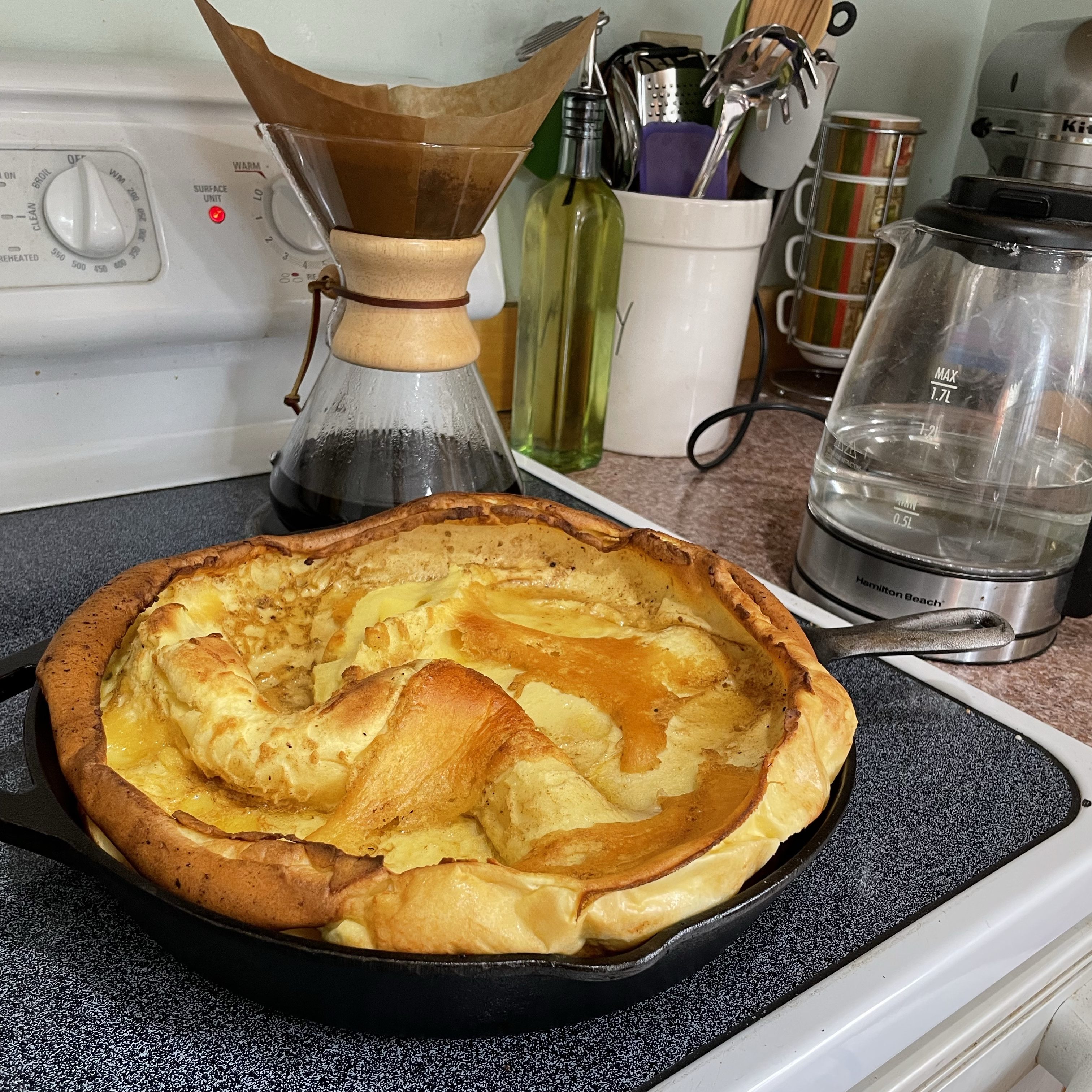
You can make Dutch babies in glass/pyrex types of dishes as well, but this recipe has been tried and tested (multiple times) in a well seasoned 10.25″ Lodge Cast Iron Skillet.
What you need:
- Immersion blender
- 10.25” seasoned cast iron skillet (we love our Lodge Cast Iron)
- 4 large eggs (room temp)
- 3/4 cup milk (room temp)
- 3/4 cup flour
- 1 tbsp sugar
- 1 tsp vanilla extract (you can use less – but I use vanilla extract in baking like I use garlic in cooking and measure with my heart!)
- 1/2 tsp salt
- 3-4 tbsp butter (room temp)
What to do:
- Make sure you have your eggs, milk, and butter out and at room temperature (we cook our breakfast meat while we wait for our ingredients to come up to room temperature)
- Preheat oven to 425° with a seasoned cast iron skillet inside (make sure to remove any handle protector while it is in the oven – the silicon ones will survive, but they aren’t my favorite, we were like the quilted ones from Lodge, but those definitely burn if you leave them in the oven – ask me how I know…)
- While cast iron and oven heat up mix your batter
- Beat/blend 4 eggs with immersion blender for about a minute (they should be light and fluffy)
- Add the rest of your ingredients (except the butter) and blend for another minute (this is a very thin batter)
- Once your oven and skillet preheat add the 3-4 tablespoons of butter to the pan (depending on how cold your house is you might need to close the oven door and make sure that the butter melts all the way)
- After the butter melts, add the batter to the pan (the way that you pour matters – if you pour it all into the middle you will have a more traditional looking Dutch Baby in the end (where the sides rise up the highest. I tend to pour in a line and get some fun shapes in the end as a result)
- Bake at 425° for the first 15 minutes
- Lower the oven temperature to 350° and bake for 5 more minutes
- Remove from the oven and serve immediately (the grand presentation of the Dutch baby fades fairly quickly once you take it out of the oven and it begins to deflate.
Serving Suggestions
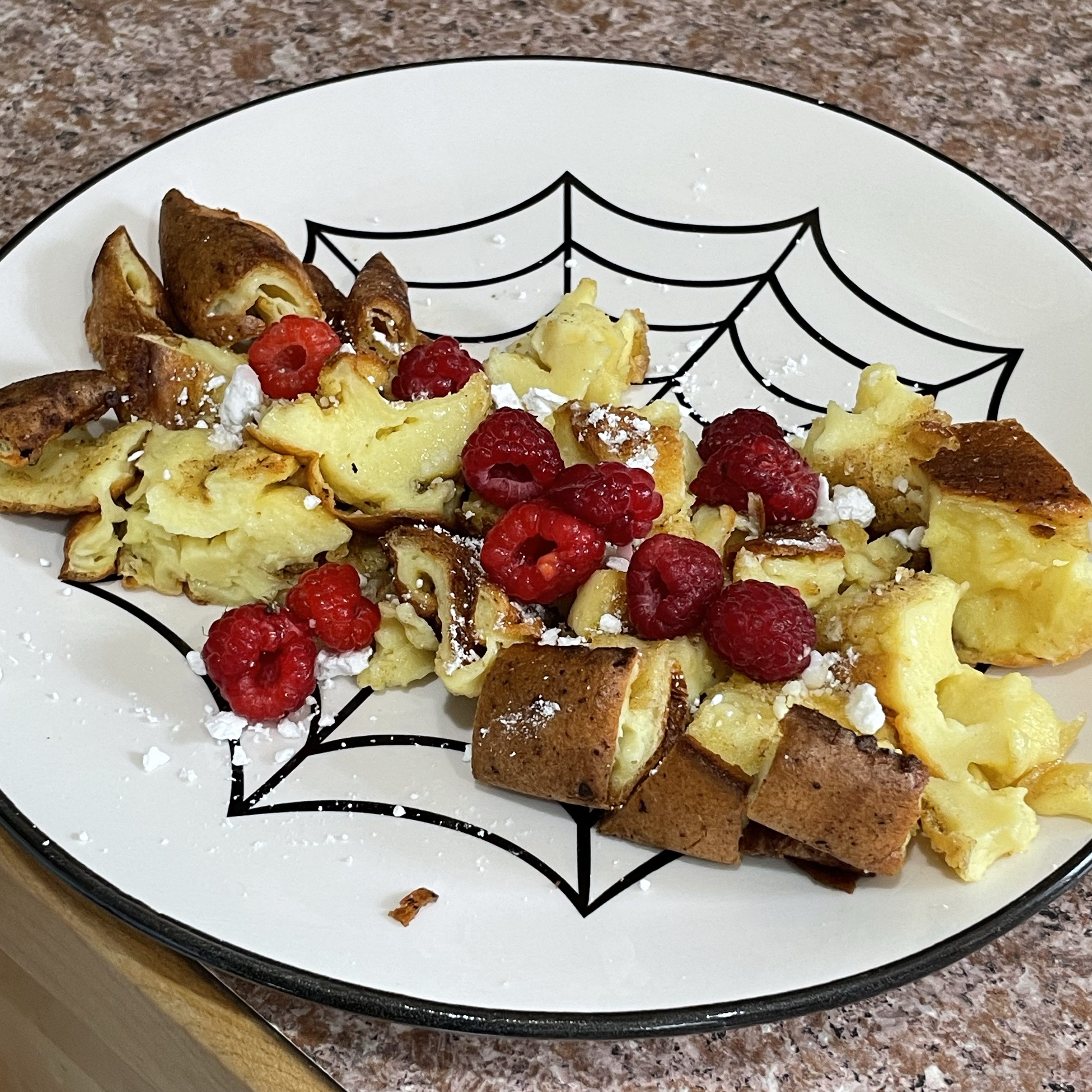
I cut this size into 4 servings. We add fresh berries in the summer, and in the fall/winter months we use frozen berries (slowly warming a cup of frozen berries in a frying pan with a tbsp of sugar.
It doesn’t happen often, but when I make a more savory Dutch baby I will use half of the sugar, so, one tablespoon instead of two.
My favorite savory Dutch baby is to serve it with dollops of cream cheese, some lox, and thinly sliced red onions. Capers would be a great addition to that version as well, it just isn’t an ingredient we keep in the house.
Another great savory breakfast option would be with prosciutto and avocado, served with a side of sliced tomatoes.
Having a well seasoned cast iron skillet can add to the flavor too. If we are having breakfast meats we usually cook those in the pan while waiting for our normally refrigerated ingredients to come up to room temperature.
Once the meat is done cooking I use a cloth napkin to wipe out the bits of meat and char left behind and we get some added essence of sausage or bacon added to our Dutch baby. Yuuuumy!
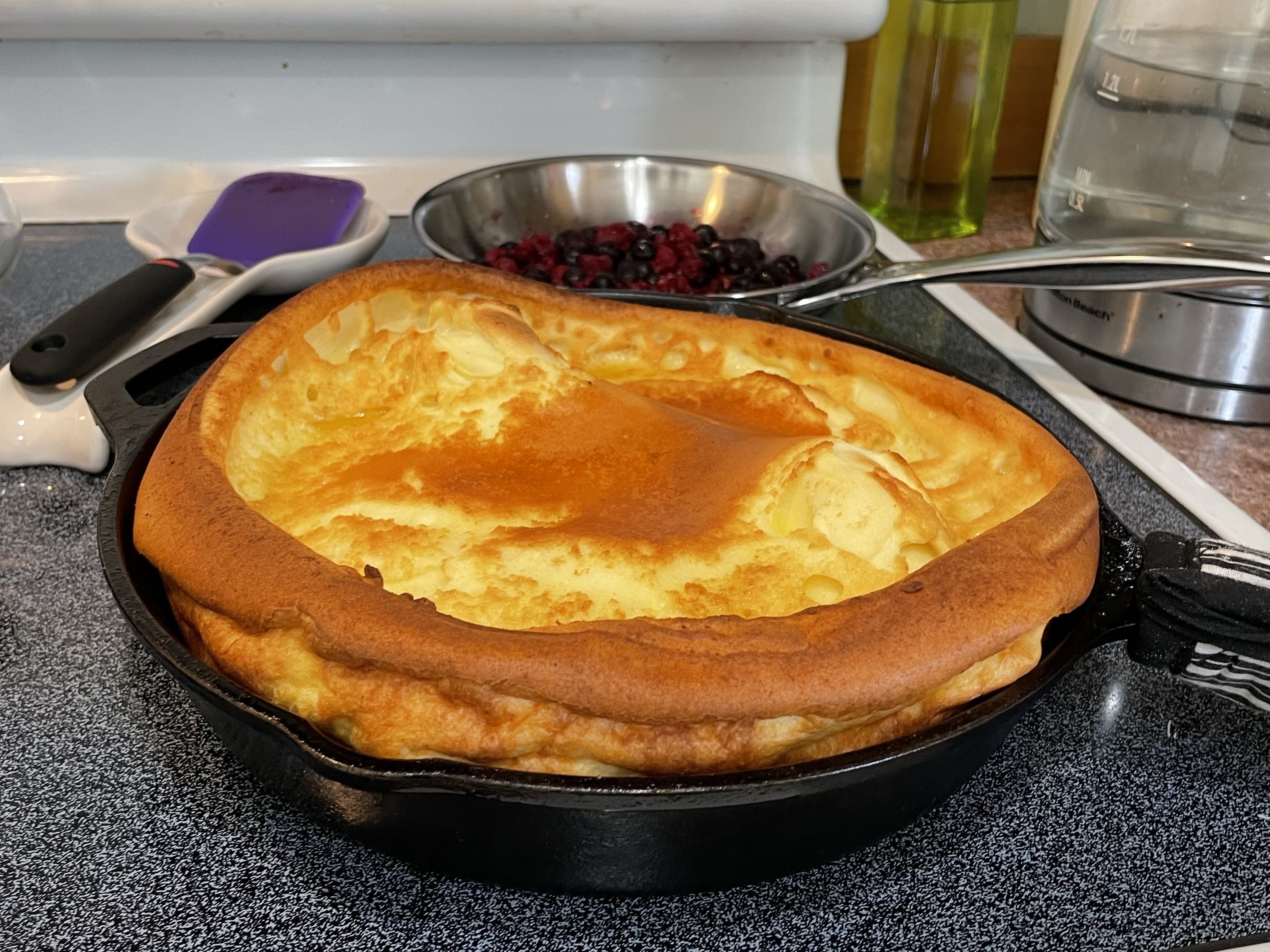
Dutch Baby Sunday is a new tradition at our home. I didn’t make a point of it, but it just happened. I wasn’t even aware it was happening until our eldest daughter told her grandmother that she couldn’t spend that night at her house on Saturdays because then she would miss out on “Dutch Baby Sunday.” Thus a tradition was born and I shall make a Dutch Baby every Sunday.
One of my favorite parts of making this is that it is a quick way to warm up our cold kitchen on crisp mornings. Sometimes we get an extra Dutch baby on a super cold week just because I want to turn the oven on!
Nothing like cozying up your kitchen with the delicious smells of a nice hot breakfast when it is chilly out.
This article contains affiliate links and our personal homesteading experiences. We receive a small commission from items purchased through our links and we appreciate every bit of support in making our home a homestead.

Enjoy the Wild with Lodge’s Newest Cast Iron Pans Fun to display and even better in use… [More]
The enameled cast iron Signature Skillet is a versatile kitchen essential for searing, … [More]

 surfandsewhomestead.com